
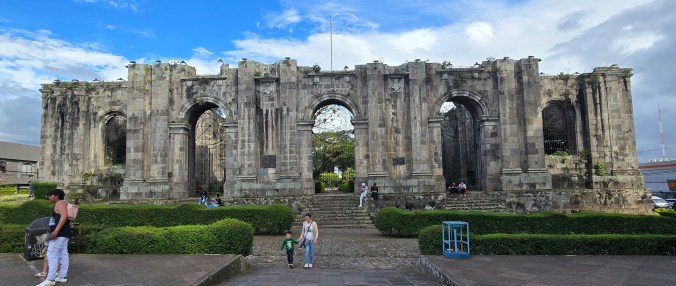


With Andrew leading the way, we walked a few streets over to the Ruins of Cartago, another church, Santiago Apóstol Parish, built in the mid 16th century and destroyed by an earthquake, for the first time, in 1630. Each rebuild, over the decades, were subsequently destroyed by earthquakes expecially the plans for the last rebuild when the 1910 Santa Monica earthquake leveled much of Cartago. Located in the absolute center of town, with serene gardens and a walking path, the ruins project a relaxing, comptemplative vibe.
The most prominent nearby statue of the Virgen de los Angeles Monument watches over the ruins. While we were taking pictures, Ivan, a tourist guide on holiday with his friends, came over and engaged us in a lively discussion about the cultural differences between San Jose, the capital, and Cartago. He indicated that the ruins served as a good meeting place frequented by the locals. We discussed the cultural differences between San José (the capital) and Cartago (former capital). According to Ivan, San José often appeals to more tourists, and has more avenues for nighttime entertainment such as dancing (which is what we were looking for). Cartago seems to focus more on local culture and history. It was interesting, though, that in Alajuela, the local folks were more inclined to wish us “Buen dia” as we walked past whereas in Cartago, people appeared to be a little more reserved. However, Ivan was very chatty and we thoroughly enjoyed the conversation.
 The Existential Vagabond